
The quiet alliance
De Gaulle & South Africa

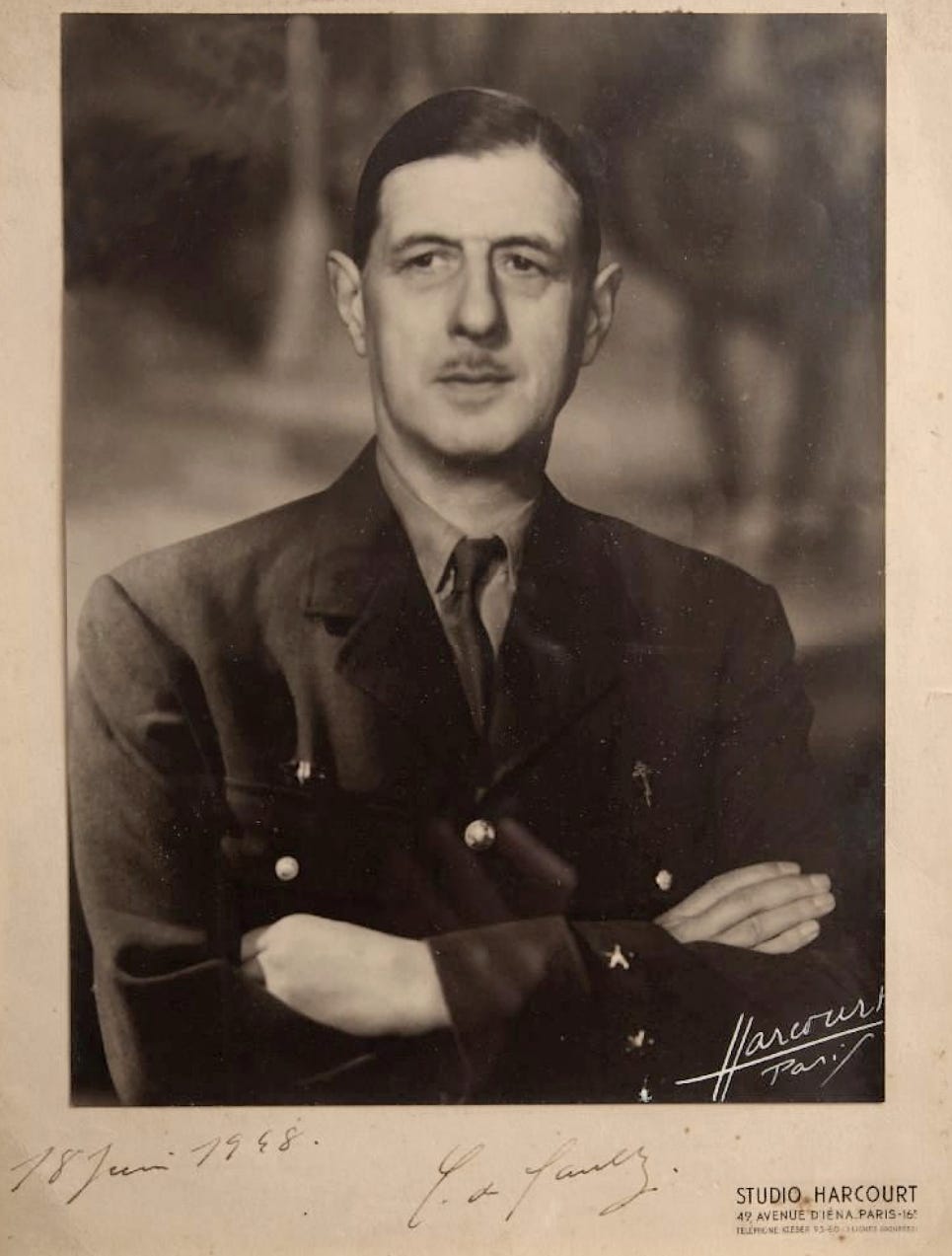
Charles de Gaulle decolonized Algeria, championed the sovereignty of new nations, and positioned France as a third great power independent of the two giants of the Cold War. He also became apartheid South Africa’s most important Western partner. Indeed, Gaullism never operated on simple moral categories, but rather on strategic ones. South Africa served French strategic autonomy, and de Gaulle acted accordingly.
The standard telling of the Cold War’s southern hemisphere treats the Western consensus on South Africa as a given. The civilized world recoiled from apartheid, imposed embargoes, and waited for history to take its course. This is a comfortable story, and it is largely false. The embargoes were selective, the moral language was strategic, and at least one major Western power refused to play along. France, under de Gaulle, looked at South Africa and saw not a pariah but a European outpost in the southern hemisphere, rich in uranium, importantly positioned between the Atlantic and the Indian Ocean, and abandoned by its natural allies for reasons that had more to do with repositioning than with principle.
Britain’s break with Pretoria was real enough, but it was driven by the politics of the Commonwealth, not by a sudden discovery of conscience. When South Africa voted to become a republic in 1961, it needed to reapply for Commonwealth membership. The Afro-Asian members made readmission impossible, and London chose the new Commonwealth over the old dominion. Labour imposed an arms embargo in 1964 and maintained it. The distancing was genuine, but it was the price of holding together a post-imperial club whose new members demanded it.
The Americans went further. Washington did not merely distance itself from South Africa; it actively sided with de-colonialist movements against its own European allies. At Suez in 1956, Eisenhower threatened Britain and France with economic sanctions and forced their withdrawal, to the practical benefit of Soviet influence in the region. Kennedy pressured Portugal, a NATO ally, over Angola, and barred it from using American weapons in its colonies1. His Assistant Secretary of State for African Affairs, G. Mennen Williams, declared that the policy of the United States would favor African regimes2. This translated into doing so even where their interests conflicted with those of NATO partners, aligning instead with the Soviet Union in the UN. In practice, Washington ran the same policy as Moscow: the dismantlement of European positions overseas.
De Gaulle saw through this, and found an opportunity. South Africa needed weapons, technology, and a great-power friend. France needed uranium for its nuclear weapons program, markets for its defense industry, and strategic depth beyond the Atlantic alliance. It was a natural fit. What followed was a consistent application of the Gaullist principle. Sovereign nations do not lecture other sovereign nations on their internal affairs. France demanded this courtesy for itself and extended it to others.
From wool to uranium
Before de Gaulle came to power in 1958, France and South Africa had no strategic relationship to speak of. The ties that existed were commercial and modest. France bought between 40 and 60 percent of South Africa’s wool production3, and the textile buyers of Roubaix were familiar figures in Cape Town. A handful of French firms operated in the country: the Banque de l’Indochine, the Compagnie Maritime des Chargeurs Réunis, and UTA, the airline. French investors held shares in South African gold mines, as they had since the 1890s, when the Banque française d’Afrique du Sud was founded to channel Parisian capital into the Witwatersrand4. But none of this amounted to a substantial political relationship. France ranked as South Africa’s sixth trading partner, behind Britain, the United States, and Germany. It was mostly private-sector based, scattered, and unremarkable.
De Gaulle returned to power and immediately found himself in a fight over Algeria that consumed his presidency and isolated France at the United Nations. South Africa was one of the very few countries that voted with France on Algeria, and de Gaulle did not forget it. In return, he never publicly mentioned apartheid. The relationship was not transactional in the crude sense, but it rested on a clear understanding: France and South Africa were both countries under siege from an international consensus they considered hypocritical, and neither saw any reason to pile on the other.
South Africa’s real value to France, though, was strategic. The country sat on vast uranium reserves at a time when France was building an independent nuclear arsenal. It occupied a commanding position between the Atlantic and Indian Oceans. And it was being abandoned by its traditional patrons for reasons that had less to do with justice than with the internal politics of the Commonwealth and the American scramble for de-colonial credibility. The gap in the market was enormous, and France was the only Western power willing to fill it.
The relationship took shape fast. After the Sharpeville massacre in March 1960, South Africa found itself losing friends in rapid succession. South Africa withdrew from the Commonwealth the following year. Britain, under pressure from its new Afro-Asian members, imposed an arms embargo in 1964. The United States had already signaled its sympathies lay elsewhere. France, alone among the major Western powers, moved in the opposite direction. The UN Security Council passed Resolution 181 in August 1963, calling on member states to embargo arms sales to South Africa. France abstained, and it expanded sales.
The transaction at the heart of the relationship was uranium. France had tested its first nuclear weapon in February 1960 at Reggane in the Algerian Sahara, and the new arsenal needed fuel. South Africa had some of the largest uranium reserves in the world, concentrated in the Witwatersrand gold mines of the Transvaal and the Orange Free State. On January 31st 1964, the two governments signed a secret agreement. France committed to purchasing 3,600 tonnes of South African uranium over four years, with options for far larger quantities in the decade to come5. The CEA planned to import up to 3,000 tonnes annually between 1968 and 1978. By the mid-1960s, South African uranium accounted for 40 percent of total French consumption6, and the price France paid, $3.62 per pound, sat below market rate. The mining chambers of the Transvaal and Orange Free State quietly stopped publishing uranium sales and stockpile figures to avoid drawing attention to where the material was going: the military enrichment plant at Pierrelatte7.
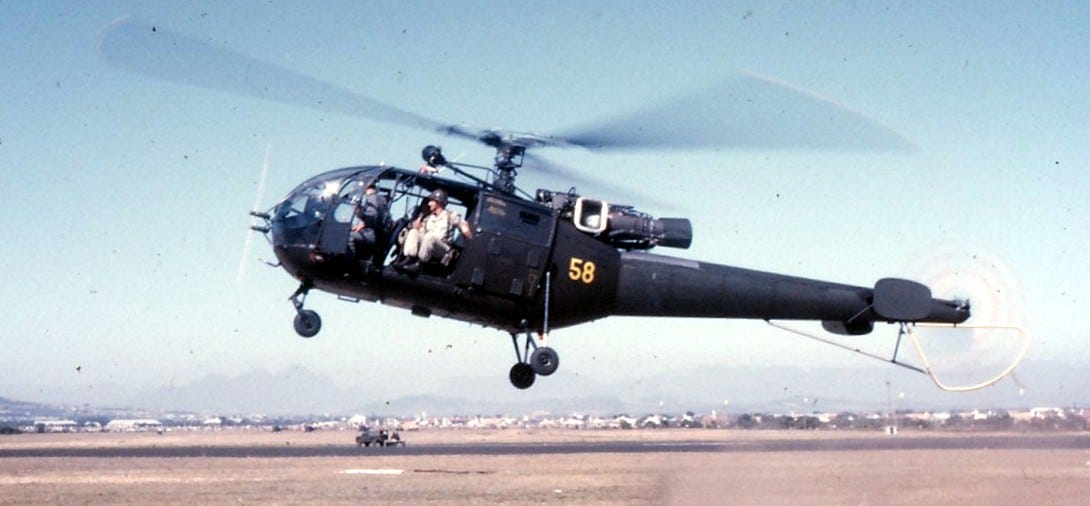
In return, France opened its arsenal. South African military officials visited Algeria from 1960 onward to observe French counter-insurgency methods, and test French equipment. Orders followed immediately. Dozens of Alouette combat helicopters, Mirage fighter jets, Daphné-class submarines, troop transports, machine guns, and radar systems. France penetrated the South African market not through the British-dominated private sector but through the Afrikaner-controlled government and military. Over half of all French loans and orders came from state corporations, which were National Party strongholds. By 1967, more than half of South Africa’s imported armaments were French. Both sides applied strict censorship, and France’s official rank as a mid-tier trading partner understated a reality that was heavily military and deliberately hidden.
De Gaulle took a personal hand in the relationship. In September 1961, he met South African Foreign Minister Eric Louw in Paris. Shortly afterward, South Africa’s military planning director, Jan Robbertze, was quietly driven to the plutonium-producing installations at Marcoule for a two-hour briefing, over the objections of the CEA, which considered the visit premature. In May 1966, when the question arose of guaranteeing enriched uranium supplies for South Africa’s SAFARI-I research reactor should the Americans withdraw, de Gaulle annotated the file himself: “Vu. Aucun inconvénient à fournir à l’Afrique du Sud de l’uranium enrichi.8” Seen. No objection to providing South Africa with enriched uranium. In February 1968, a South African delegation led by Victor Verster and Hendrik Samuels of the Munitions Production Board visited Paris and reported being “given the open sesame everywhere,” including the highest security classification centers9. Verster concluded the instructions came directly from de Gaulle, who “passed down the word that no information in which the mission was interested was to be denied.” The president’s son, Philippe de Gaulle, accompanied part of the tour. Hervé Alphand, Secretary-General of the Quai d’Orsay10, told the South African ambassador the same month that “South Africa was getting whatever it wanted from France” but “should always take the greatest care to play things quietly.”
More than a Mirage
The scale of French arms sales to South Africa deserves a closer look as it was the backbone of South Africa’s military. The Alouette helicopter became the workhorse of its counter-insurgency operations. The Mirage III and later variants gave Pretoria air superiority across the subcontinent. Daphné-class submarines extended South African naval reach into the Indian Ocean. Electronic warfare systems, radars, troop transports, and machine guns rounded out what amounted to a full-spectrum military dependency on French industry.
In 1964, Thomson-Houston and Matra began developing a surface-to-air missile system designed to protect static positions against low-altitude air threats, the Cactus. South Africa financed 85 percent of the research and development costs11, and sixteen engineers from the National Institute for Defence Research trained at Thomson-Houston and Matra laboratories in France, participating directly in the design work. The first experimental test took place at the French missile centre at Colomb-Béchar in Algeria in late 1965. South African propulsion engineers then applied for training at French ballistic technology facilities, including SNPE plants and the ballistic laboratories at Sevran and Le Bouchet. When the system entered production, Thomson-Houston and the South African Armaments Corporation shared the licence equally, a 50/50 split that reflected the transition from South African-funded development to joint industrialization. The French army adopted the same weapon under the name Crotale. It was, in effect, a missile co-developed with South Africa, deployed by both countries, and financed overwhelmingly by Pretoria.
France also sold something more durable than finished weapons, the ability to produce them. South Africa purchased manufacturing licenses from French companies, allowing it to build Mirages and other systems domestically. This served both parties. South Africa gained industrial self-sufficiency at a time when international opinion was turning against it. France gained commercial discretion, since weapons produced under licence in South Africa no longer appeared as French exports. A second technique involved routing sales through friendly third countries. In 1971, the Quai d’Orsay’s economic department suggested using Brazil and Argentina as intermediaries to obscure the origin of French equipment12.
The same pattern applied to armored vehicles, the most notable case being the Eland. In 1961, South Africa negotiated a licensing agreement with Panhard for the AML, a light armored car designed for reconnaissance and counter-insurgency. South Africa purchased a hundred vehicles outright and secured licenses from both Panhard and the French government’s Direction technique des armements terrestres (DTAT) to manufacture the rest domestically. The result was the Eland, built by Sandock-Austral in South Africa, identical in origin to the French original but carrying a South African name and leaving no trace in French export statistics.
Alouettes flew counter-insurgency missions along the Namibian border and in operational zones across the subcontinent. Mirages provided air superiority against neighboring states that were arming with Soviet equipment. Cactus batteries protected military installations and airfields from the air. The Eland became one of the most recognizable vehicles of the Border War. In 1975, Eland 90s were the primary armored asset in Operation Savannah, the SADF’s deep incursion into Angola, where they engaged Cuban and Angolan tanks hundreds of kilometers from the nearest South African base. French procurement, taken together, served all the operational needs of the South African armed forces at the time.
Nuclear twins
The historian Anna Konieczna, who spent years in the French and South African archives, describes the two countries as “nuclear twins”13. Their cooperation on atomic matters was intentional, bilateral, supervised at the highest levels, and sustained across three French presidencies. It began with uranium and ended with enrichment technology, and at every stage, French leaders knew exactly what they were enabling.
From 1966, the CEA’s laboratories at Le Bouchet and Pierrelatte carried out test conversions of South African ore into uranium tetrafluoride and hexafluoride, working alongside South Africa’s National Institute of Metallurgy and NUFCOR. French companies designed and built the infrastructure for South Africa to do this on its own soil. SETU constructed a UF4 conversion plant at Zuurbekom in 1968. Comurhex and Péchiney built a UF6 plant at Pelindaba, completed in 1975, for the South African Uranium Enrichment Corporation, UCOR. These were the essential upstream steps in the nuclear fuel cycle. Without them, South Africa’s uranium ore was commercially and militarily inert. France supplied the technology that made it usable.
As Minister of the Armed Forces from 1960 to 1969, Pierre Messmer supervised the industrialization of the Cactus missile and corresponded personally with his South African counterpart, Pieter Botha. The South African ambassador in Paris believed Messmer had persuaded fellow ministers to export “ultra-sensitive materials” despite UN and NATO pressure. In October 1970, Messmer spent two weeks in South Africa as Botha’s guest, meeting Prime Minister Vorster, all the Chiefs of Staff, and Ampie Roux, president of the Atomic Energy Board. He visited the Pelindaba nuclear centre. When he became Prime Minister in 1972, the CEA’s remaining internal opposition to the UF6 plant sale evaporated14.
On February 26 1974, the CEA and UCOR signed a cooperation agreement on uranium enrichment. Conversion plants turned ore into feedstock, and enrichment turned feedstock into fuel, or into weapons material. What followed were the PUMA feasibility studies, running from May 1974 to February 1975, which included reciprocal visits to the military enrichment installations at Valindaba and Pierrelatte. In May 1975, André Giraud, the CEA’s Administrator General, planned to offer South Africa a three-year secret consultancy for a prototype commercial enrichment plant, the “mini Z” project. An agreement was probably reached in June 1976. South Africa’s Y Plant began initial cascade operations in late 1974, with the CEA involved in commissioning. The first feedstock of un-safeguarded UF6 reportedly came from France.
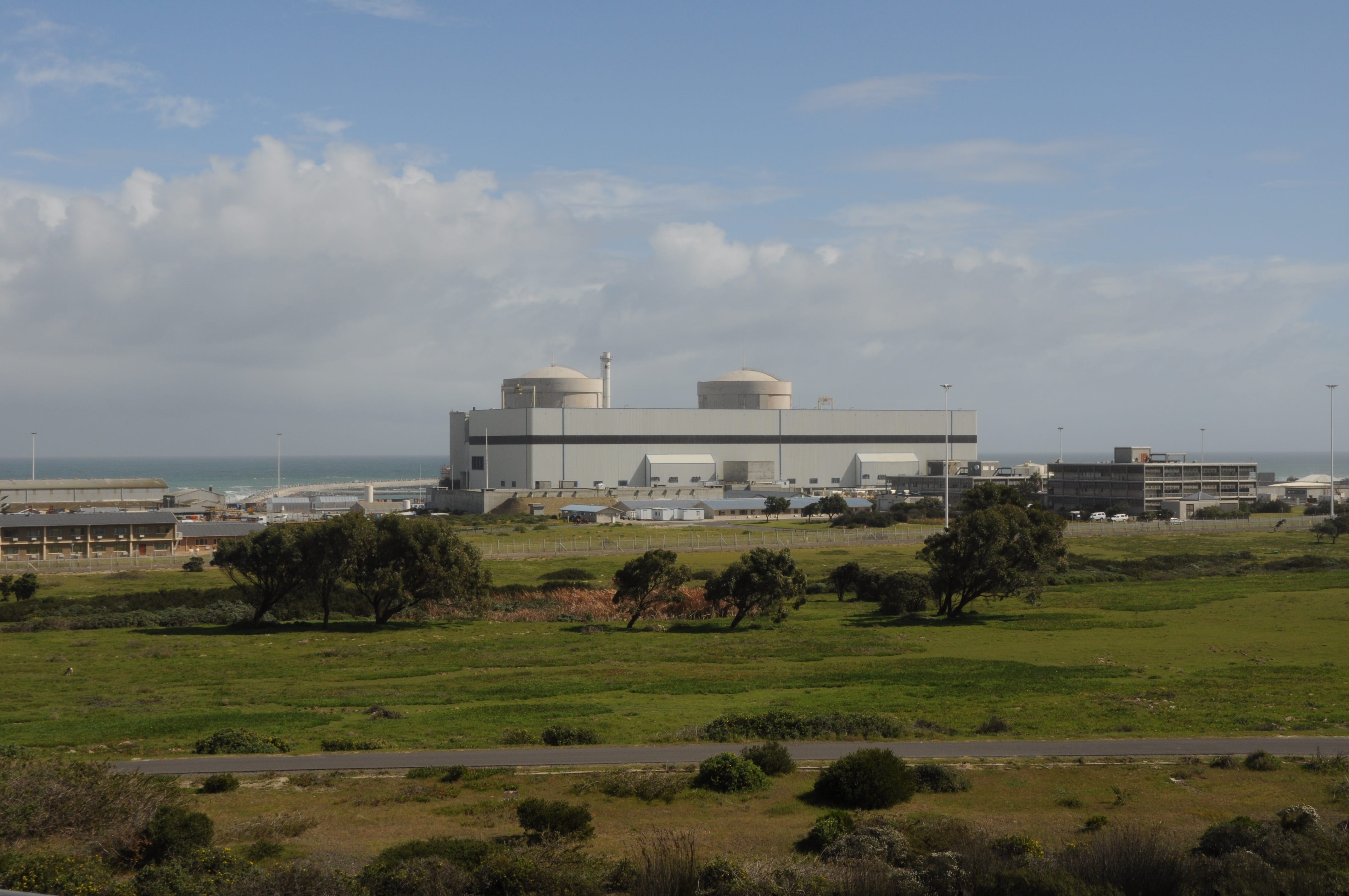
South Africa’s electricity utility, ESCOM, initially awarded the Koeberg reactor contract to an American-Swiss-Dutch consortium. South African archives suggest that the CEA linked its secret consultancy on enrichment to Framatome winning the tender instead. In early June 1976, ESCOM withdrew from the original consortium. On August 5th and 6th 1976, contracts were signed with Framatome in Johannesburg and Paris. Framatome also agreed to assist ESCOM in establishing a fuel manufacturing plant, which opened in 1986. France applied safeguards to the most visible transfers while leaving enrichment, fuel manufacturing, and missile technology outside the system.
Over the course of the 1980s, Pretoria assembled six nuclear weapons, with a seventh under construction when the program was dismantled in 1989. The first operational device was completed in December 198215. The strategic doctrine that governed their use drew on French thinking as directly as the technology did. André Beaufre’s concept of “stratégie totale,” outlined in his 1963 “Introduction to Strategy,16” became the intellectual framework for South Africa’s “total onslaught” doctrine. The 1977 Defence White Paper drew directly from Beaufre, and, as the scholar Philip Frankel noted, “virtually every course at the Joint Defence College is based on one or other of Beaufre’s strategic works.17” South Africa’s nuclear posture mirrored what Israel called “amimut,” nuclear opacity: never confirm, never deny, use ambiguity as deterrence. Both were regionally isolated states facing existential threats, and both had French foundations at the heart of their nuclear programs.
Shadow diplomacy
The arms sales and nuclear cooperation were managed through official channels such as the CEA, the Defence Ministry, the Quai d’Orsay. But the broader architecture of France’s southern African policy ran through a parallel system, one built on personal networks, informal diplomacy, and trusted intermediaries who operated between governments without appearing on any organizational chart. The architect of this system was Jacques Foccart, de Gaulle’s adviser on African affairs, and the key operative was Jean Mauricheau-Beaupré18.
Mauricheau-Beaupré was close to both Foccart and Michel Debré. He served as adviser to Abbé Youlou, president of Congo-Brazzaville, from 1960, and then to Félix Houphouët-Boigny of the Ivory Coast from 1963. In the early 1960s, he built a network of contacts with South African intelligence services, and he favored deep coordination between the conservative regimes of the region: South Africa, Rhodesia, and the Portuguese territories. His vision was an informal alliance of anti-communist states across southern Africa, cooperating to counter pan-African projects while preserving Western interests. Pretoria provided economic, military, and paramilitary support for operations that Mauricheau-Beaupré ran across the continent. On the ground, contacts between the Ivorian and Gabonese presidents and South Africa were conducted through him or in his presence, with Philippe Lettéron, posted to the Ivorian and Gabonese presidencies, serving as the other permanent link.
The Ivorian president Houphouët-Boigny, one of the most visible faces of this arrangement, was the pillar of French presence in West Africa and one of Foccart’s closest allies. Ivorian diplomacy remained officially critical of apartheid until at least 1967, but in private conversations with the French ambassador in Abidjan, Houphouët had been favorable to a more constructive approach to Pretoria well before that. His overtures became public from 1968, motivated by competition with Nigeria for West African leadership after Nkrumah’s overthrow in Ghana, the shift of pan-African momentum eastward to Nyerere and Kaunda, and the escalation of liberation movements in southern Africa. Houphouët framed his approach in anti-communist terms: “The main African struggle is not between racists and non-racists. The real struggle is between communists and anti-communists.” South Africa, in this framing, was the key element of a common barrage. In 1975, he sent Laurent Dona Fologo on an official visit to South Africa as “dialogue diplomacy,19” an attempt to engage Pretoria through conversation rather than isolation. Vorster’s own “outward policy,” launched in 1967, sought the same convergence from the other side: diplomatic relations with Lesotho and Malawi, a customs union with Botswana, Lesotho, and Swaziland in 1969, and quiet engagement with francophone Africa through Paris.
When Nigeria’s Eastern Region declared independence as Biafra in 1967, Houphouët-Boigny worked in two directions through Foccart’s channels: diplomatic recognition (Tanzania, Gabon, the Ivory Coast, and Zambia all recognized Biafra in 1968) and military aid transiting through Libreville. From 1969, South Africa provided military assistance via Angola. At an OCAM conference in Kinshasa in January 1969, the Ivory Coast, Gabon, and Madagascar agreed to establish “a realistic policy toward South Africa on a continental scale.” South Africa later extended credit that probably helped finance the Ivorian budget deficit. French strategic interests, francophone African regimes seeking patrons, and South African money and military capacity all fed into one another.
After the UN Security Council voted binding sanctions against Ian Smith’s government in May 1968, Smith wrote directly to de Gaulle asking France to continue trading through third countries. France obliged. Through Mauricheau-Beaupré and Lettéron, Franco-Rhodesian relations continued throughout the 1970s. The Rhodesian armed forces operated with French equipment: some fifty Alouette helicopters, Mirages, and Matra rockets, according to the historian Joanna Warson. France’s position was consistent. It had abstained on the 1963 arms embargo resolution against South Africa. It abstained again on the 1963 resolution calling for an end to arms deliveries to Portugal’s colonies. When binding sanctions came for Rhodesia, the formal compliance masked an informal continuity. The principle was the same one that governed the relationship with Pretoria. Sovereign decisions about trade and strategic partnerships were France’s to make, and international pressure was not a sufficient reason to abandon an ally.
This was not merely a rogue operation run by a handful of officials acting beyond their mandate. The key figures occupied positions at the centre of the State. Maurice Papon visited South Africa in December 1967 as president of Sud-Aviation, the state aerospace company that manufactured many of the aircraft and helicopters France sold to Pretoria. His career before that appointment traced a path characteristic of the Fifth Republic: Vichy administrative official in the Gironde, Prefect of Constantine during the Algerian war, infamous Prefect of Police in Paris from 1958 to 1967, and then head of a state arms manufacturer. Papon was typical of the senior Vichy-era civil servants whom de Gaulle reused extensively to staff the institutions of the new republic. They knew how to run the state, and the state needed running.
The intellectual dimension of the relationship ran through two strategists, Pierre Gallois and André Beaufre as previously mentioned. Gallois had visited South Africa as early as 1957 on commercial missions for OFEMA, and after Papon’s visit in December 1967, he sent English translations of his books to Lieutenant-General Charles “Pop” Fraser, the South African Chief of the Army: “Balance of Terror” and “Paradoxes de la Paix.20” Gallois and Beaufre were the theorists of French nuclear deterrence, and their ideas shaped South African strategic doctrine as directly as French technology shaped South African weapons.
Foccart tied the political and intelligence dimensions together. He personally met South African diplomats, intelligence representatives, and the South African Defense Minister on multiple occasions. From 1969, the South African embassy in Paris, led by Albertus Burger, a former adviser on African affairs to Verwoerd and Vorster, became a point of contact for francophone African leaders visiting France. Foccart managed these intersections. His journal and Pierre Péan’s biography do not clarify his personal views on the arms trade or nuclear cooperation, but they did not need to. The system worked because the men who ran it shared a set of assumptions about French interests, European solidarity, and the irrelevance of international moral pressure to sovereign decisions. They did not need to agree on ideology. The national interest was enough.
Continuity
De Gaulle resigned in April 1969, but the relationship with South Africa went on. Each of his successors inherited the partnership, learned its full extent, and chose not to end it. This was the surest sign that the policy was no longer a personal project but had become a structural feature of the Fifth Republic.
Georges Pompidou learned of the nuclear dimension in June 1970, when Ampie Roux, president of South Africa’s Atomic Energy Board, made a formal offer of enrichment cooperation. Pompidou called an emergency meeting. He refused to make a formal commitment, but he agreed to a secret CEA inquiry into South Africa’s enrichment process. The door stayed open. Pompidou’s instinct was to protect France’s international image while preserving its commercial advantage, and the easiest way to do both was to let the technical agencies continue their work without leaving a political paper trail. He considered Houphouët-Boigny’s dialogue with Pretoria “premature,” not because he opposed it in principle but because he thought the timing was wrong. The Quai d’Orsay’s Africa directorate agreed. The dialogue should remain an “African initiative,” not something Paris was seen to orchestrate.
Valéry Giscard d’Estaing took office in May 1974 and learned about the cooperation three months later. He did not ask for the feasibility studies to be interrupted nor did he oppose the secret assistance plans. Bertrand Goldschmidt, one of the founders of the CEA, explained the operating logic21: France “did not wish to help another country to make the bomb or to be seen as helping in this direction. However, if another country, completely of its own, found ways of making a bomb, that was another matter.” This was the formula that allowed the relationship to continue across three presidencies. France provided the technology, the training, and the consultancy. South Africa made the sovereign decision to build weapons.
The regional picture was shifting rapidly as Angola and Mozambique gained independence in 1975, after the Portuguese empire collapsed. White minority rule in Rhodesia was ending. SWAPO was pressing for Namibian independence. The buffer states that had shielded South Africa from the rest of the continent were falling away one by one. Under these conditions, Pretoria resolved to guarantee its own security. The nuclear weapons program accelerated through the late 1970s, and the strategic doctrine hardened.
Then Washington increased the pressure. On March 10th, 1978, President Carter signed the Nuclear Non-Proliferation Act22, which banned the export of South African uranium to France and its re-export back to South Africa as enriched fuel. This cut Pretoria off from France as a fuel source for the Koeberg reactors then under construction, and froze all American enriched uranium exports to South Africa. The following month, P.W. Botha approved a three-phase nuclear deterrence strategy: first, strategic ambiguity; second, if danger became imminent, quietly warn Western allies of nuclear capability; third, if danger became foreseeable, announce the capability publicly. It was a strategy aimed squarely at the United States.
Prime Minister Vorster articulated the South African view in a letter to Carter that now sits in the Wilson Center Digital Archive: “The United States officially holds the view that stability in Southern Africa and the future of our country is to be sacrificed in the hope of stopping Soviet expansionism.23” The complaint was not that Washington opposed apartheid. It was that Washington had decided South Africa was expendable, a piece to be traded for African goodwill in a larger game against the Soviet Union. France, whatever its public posture, had never made that calculation. Pretoria never forgot it.
Sovereignty without reservations
The man who decolonized Algeria and the man who armed Pretoria operated on the same principle. Sovereign nations do not tell other sovereign nations how to run their internal affairs. De Gaulle demanded this for France, and he extended it to others. South Africa was sovereign and had the right to conduct its own affairs without foreign interference.
South Africa, in the Gaullist view, was a European outpost in the southern hemisphere. It occupied a strategic position between the Atlantic and the Indian Ocean, held vast reserves of uranium and minerals essential to Western industry, and stood as the only state in sub-Saharan Africa capable of projecting military power across the region. Supporting it was an act of European solidarity, grounded in shared strategic interests, and in the recognition that European communities abroad deserved the backing of their mother continent. The internal arrangements of the South African government were South Africa’s affair.
The Anglo-American embargo was not the purely moral act its authors claimed. Britain abandoned South Africa because holding the new Commonwealth together required it. The United States sided with decolonialist movements because of a purported strategy of competing with the Soviet Union for African allegiance which required it. Both dressed strategic repositioning in the language of principle, and both expected France to follow. France refused, not because it endorsed apartheid but because it saw the embargo for what it was and because South Africa served French interests that no amount of international moralizing could replace: uranium for the nuclear deterrent, markets for the defense industry, and a strategic anchor in a part of the world where France intended to remain present.
What the Franco-South African partnership reveals, in the end, is what Gaullism looks like when applied without reservations. It means accepting that allies are sovereign, that strategic relationships serve the national interest, and that moral consensus imposed from international institutions, or the veneer of it, is not binding on a nation that has decided to think for itself. De Gaulle built France’s independent nuclear deterrent, withdrew from NATO’s integrated command, and armed South Africa. They were applications of the same idea.
For South Africa, the meaning of this history is simpler and more personal. When it was pushed out of the Commonwealth, when Washington decided it was expendable, when the United Nations voted embargo after embargo, France stayed. It sold the means for their defense, built the reactors, trained the engineers, and never once demanded that Pretoria justify itself on the conduct of their own affairs. The Afrikaners who lived through those decades know what it means to have one friend when everyone else has left the room. That friend was France. While Afrikaners hold an undeniable and native connection to their land, their distant ties to the home continent proved invaluable. Europe today, caught between American strategic demands it did not choose and a world order it no longer controls, might benefit from remembering what that kind of loyalty once looked like, and what it was worth.
On 15 March 1961, the Kennedy administration voted at the United Nations against Portugal, France, and Britain — its own NATO allies — in favor of Angolan independence, aligning with the Soviet Union on the vote. Portugal threatened to terminate the Azores base agreement in response. See Philip E. Muehlenbeck, Betting on the Africans: John F. Kennedy’s Courting of African Nationalist Leaders (Oxford University Press, 2012); or Foreign Relations of the United States, 1961–1963, Volume XXI, Africa
Williams’ exact words, at a February 1961 press conference during his first Africa tour, were “what we want for the Africans is what the Africans want for themselves,” reported in the press as “Africa for the Africans.” Kennedy defended the remark publicly. British MPs raised formal complaints in the House of Commons.
Founded in 1895 by Jacques de Gunzbourg for gold mining investment; merged into the Banque française pour le Commerce et l’Industrie in 1901.
Anna Konieczna, “Nuclear twins: French-South African strategic cooperation (1964-79),” Cold War History 21, no. 3 (2021), DOI: https://doi.org/10.1080/14682745.2020.1823968. The contract was extended three times (December 1964, June 1965, and probably December 1966).
Bertrand Goldschmidt admitted this figure in 1966. Konieczna (2021) confirms it for the 1964-1973 period.
The first section (low enrichment) became operational in 1964; full weapons-grade capability was achieved in April 1967.
Note, “Note à l’attention du général de Gaulle sur la demande de livraison d’uranium enrichi par l’Afrique du Sud,” Paris, May 21st 1966, Box 90, Fonds Sébastian Loste (640AP), National Archives of France
Konieczna (2021), citing South African Department of Defense archives.
Alphand served as Secretary-General of the Minister of Foreign Affairs from 1965 to 1972.
Hennie van Vuuren, Apartheid, Guns and Money (Johannesburg: Jacana, 2017). The subsequent 50/50 license split between Thomson-Houston and the South African Armaments Corporation refers to the industrialization phase, not R&D. Confirmed by Konieczna (2021).
Thomas Deltombe, Manuel Domergue, and Jacob Tatsitsa, L’Empire qui ne veut pas mourir: Une histoire de la Françafrique (Paris: Seuil, 2019).
Anna Konieczna, “Nuclear twins: French-South African strategic cooperation (1964-79),” Cold War History 21, no. 3 (2021), DOI: https://doi.org/10.1080/14682745.2020.1823968.
See also her doctoral thesis: “L’histoire d’une relation spéciale: les relations entre la France et l’Afrique du Sud dans les années 1958-1974” (Sciences Po, 2013), available at https://sciencespo.hal.science/tel-03986027/.
Codenamed “Hobo”/”Cabot.”
André Beaufre, Introduction à la stratégie (Paris: Armand Colin, 1963). English translation: An Introduction to Strategy (London: Faber & Faber, 1965).
Philip Frankel, Pretoria’s Praetorians: Civil-Military Relations in South Africa (Cambridge University Press, 1984)
Jacques Foccart: Archives ouvertes (Paris: PUPS, 2017). See also https://journals.openedition.org/ccrh/512, Cahiers du Centre de Recherches Historiques.
Fologo reportedly denounced apartheid during the trip.
Pierre Gallois, Stratégie de l’âge nucléaire (Paris: Calmann-Lévy, 1960), published in English as The Balance of Terror (Boston: Houghton Mifflin, 1961); and Paradoxes de la Paix (Paris: Presses du Temps Présent, 1967)
Goldschmidt was a nuclear chemist who participated in the Manhattan Project and co-founded the CEA in 1945.
Public Law 95-242, signed March 10th, 1978.